ENG
ENG  Español
 ENG
ENG CAT
CAT
Dry canyons in Catalonia and the Pyrenees
Dry canyons are one of the best alternatives for continuing to practise canyoning during the months when colder temperatures make aquatic descents less appealing. In Catalonia, the Pyrenees and other parts of Spain, there are routes where progression is mainly on foot, with downclimbs and rappels, without the need to swim or spend long periods in the water.
If you have arrived here searching for dry canyons in Catalonia, dry canyons in the Pyrenees or dry canyons in Spain, this guide explains what they are, when to do them, what equipment you need and what you should consider before entering one.
In addition, in the Pallars Jussà, very close to La Pobla de Segur, we have three particularly interesting options: Gramontill Canyon, Serradell Canyon and Moró Canyon.
Contents
What is a dry canyon?
A dry canyon is a canyon or streambed where there is normally little or no water during a large part of the year.
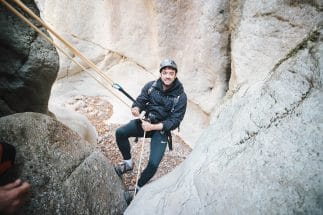
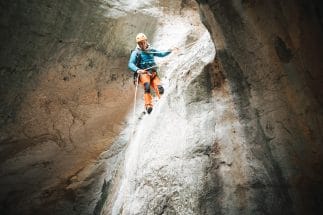
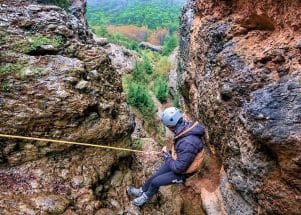
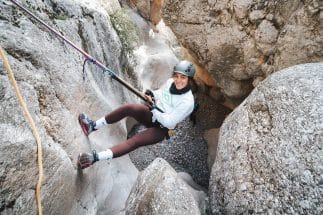
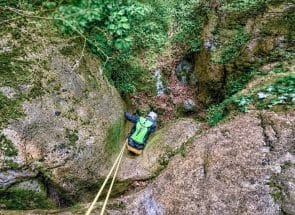
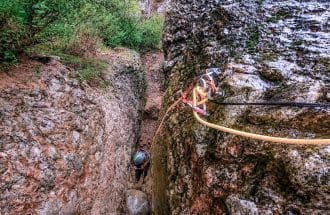
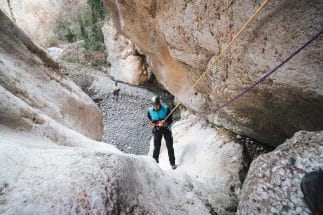
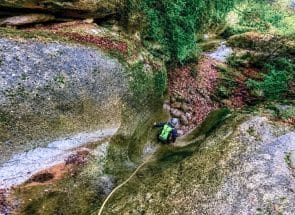
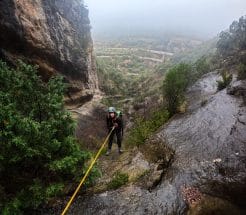
Progression is mainly on foot along the canyon bed, overcoming natural drops, downclimbing and using ropes for rappels whenever the terrain becomes vertical.
This does not mean that a dry canyon is necessarily easy.
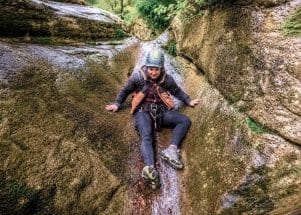
Removing the aquatic element reduces some difficulties related to water flow, swimming or water temperature, but vertical obstacles, polished rock, loose terrain, exposure and rope manoeuvres are still present.
For this reason, dry canyoning remains a genuine mountain activity.
What is a dry canyon descent like?
A dry canyon descent uses many of the same techniques as traditional canyoning.
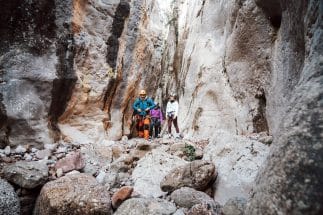
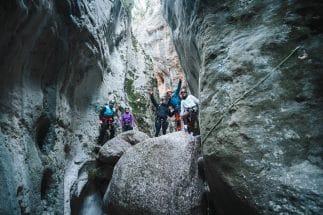
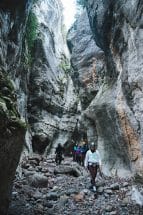
During the activity, we progress through the canyon bed and encounter different natural obstacles. Depending on the route, there may be short downclimbs, narrow passages, large rock blocks and, above all, rappels.
The rope plays a particularly important role here.
Because there are fewer swimming sections, jumps or water slides, the descent allows you to focus much more on techniques such as:
- Correct positioning and control during a rappel.
- Proper use of the descender.
- Rope management.
- Progression through anchor stations.
- Communication between participants.
- Reading the rappel line.
- Moving safely over irregular or polished rock.
For this reason, dry canyons can also be an excellent environment for improving technical skills.
Want to discover the dry canyons of the Pallars Jussà?
We organise guided descents adapted to your experience, from beginner options to routes with a greater continuity of rappels.
Winter canyons: dry canyons
Talking about winter canyons – dry canyons makes perfect sense because this type of route extends the traditional canyoning season.
During autumn and winter, entering a very aquatic canyon can be less appealing for people who are not used to cold conditions.
In a dry canyon, on the other hand, you can wear mountain clothing suited to the outside temperature and enjoy the descent without remaining constantly in the water.
This makes them an excellent option for continuing to practise canyoning during the colder months.
However, winter also brings other challenges.
There are fewer daylight hours, temperatures can drop quickly and some sections of rock may remain wet, icy or particularly slippery.
For this reason, it is important to allow extra time and adapt the equipment to the conditions.
Dry canyons in Catalonia
Dry canyons in Catalonia are a very interesting alternative to traditional aquatic canyoning.
The geological diversity of the region makes it possible to find routes with very different characteristics: narrow canyons, open gullies, conglomerate descents, limestone and sectors dominated by large vertical drops.
Many canyons also behave differently depending on the season.
A route that is almost completely dry during certain months may carry water after a period of rainfall.
For this reason, describing a canyon as “dry” never replaces checking the real conditions before starting.
For anyone looking for dry canyons in Catalonia, inland Lleida and especially the Pre-Pyrenees offer very interesting possibilities.
Dry canyons in the Pyrenees
Dry canyons in the Pyrenees allow you to discover a different side of this mountain range.
We usually associate Pyrenean canyoning with crystal-clear rivers, large pools and flows fed by snowmelt, but there are also routes where the main elements are rock and vertical rope manoeuvres.
Dry canyons in the Pyrenees are particularly interesting during autumn and winter.
They can also be combined with other mountain activities and are ideal for technical days focused on learning or improving rope-handling skills.
Dry canyons in Lleida
Dry canyons in Lleida are particularly interesting thanks to the morphology of the Pre-Pyrenees and the Pyrenees in the province.
In areas such as the Pallars Jussà, there are several descents located very close to one another, making it easy to organise a day with one canyon or combine several activities.
This proximity is a major advantage.
Instead of spending many hours travelling, we can adapt the programme to the group, the weather and the pace of the participants.
For a first experience, we can choose a gentler route. For people who are already confident with rappelling, we can organise an activity with greater vertical continuity.
Dry canyons in Huesca and dry canyoning in Guara
Searches for dry canyons in Huesca and dry canyoning in Guara are also very common among canyoning enthusiasts.
The Sierra de Guara is one of Europe’s major canyoning destinations and offers an enormous variety of routes.
However, a canyon should never be chosen only because it normally carries little water.
Rainfall can completely change the behaviour of a canyon.
For any outing in Huesca or Guara, it is essential to analyse the weather forecast, recent rainfall and the characteristics of the route.
A canyon that appears dry can change dramatically after a storm.
The basic rule is simple: dry does not mean risk-free.
Three dry canyons near La Pobla de Segur
In the Pallars Jussà, we have three particularly interesting routes for anyone who wants to discover dry canyoning.
All of them are located very close to La Pobla de Segur, making it possible to create different combinations depending on the group’s level.
Gramontill Canyon
The Gramontill Canyon is a very interesting option for practising technique and becoming more confident with rope manoeuvres.
Its characteristics make it suitable either as a standalone activity or as the first descent of a combined canyoning day.
It is especially recommended for anyone who wants to improve rappelling position, communication and equipment management without adding the aquatic element.
Serradell Canyon (Bosc de Serradell)
The Serradell Canyon, also known as Bosc de Serradell, is one of our preferred options for beginners.
It offers a real canyon atmosphere while allowing each manoeuvre to be carried out calmly and the basic techniques to be practised before moving on to more demanding routes.
It can be an excellent choice for mixed groups or for people completing a dry canyon descent for the first time.
Moró Canyon
The Moró Canyon has a slightly more vertical character and a greater continuity of rope manoeuvres.
It is a very interesting option for people who already have some rappelling experience and are looking for a descent with a more continuous rhythm.
Group organisation and correct rope management become even more important here.
Not sure which dry canyon to choose?
Tell us about your experience, how many people are in your group and what kind of activity you are looking for. We will recommend Gramontill, Serradell, Moró or another option depending on the conditions on the day.
How difficult is a dry canyon?
There is no single difficulty level.
You can find everything from beginner-friendly routes to descents with significant vertical sections and multiple rappels.
The difficulty depends on factors such as:
- Length of the route.
- Number and height of the rappels.
- Type of rock.
- Condition of the anchors.
- Possibility of exiting the canyon.
- Terrain conditions.
- Group size and experience.
For beginners, technical difficulty is not the only factor.
A new group needs more time for each manoeuvre, so a short route can often be much more suitable than a long descent that appears easy.
Equipment required for dry canyoning
The fact that there is no water does not eliminate the need for specialised equipment.
In general, you will need:
- Helmet.
- Suitable harness.
- Safety lanyards.
- Descender.
- Locking carabiners.
- Ropes suitable for the vertical sections of the route.
- Footwear with good grip.
- Mountain clothing suitable for the temperature.
Gloves can be particularly useful on routes with many rappels.
In autumn and winter, we also recommend carrying a headlamp, even if you plan to finish during daylight. Daylight hours are limited and any incident can significantly delay the descent.
When is the best time for dry canyons?
Autumn and winter are two of the best seasons.
During these months, aquatic routes can be too cold for some groups, while a dry canyon allows you to continue enjoying the mountains.
Spring can also be a good option as long as the weather is stable.
After heavy rain, extra caution is required.
A canyon that is normally dry can carry water, and even a small flow can completely change the conditions of certain sections.
Looking for another winter canyoning experience?
Besides dry canyons, winter is also a great time to try thermal canyoning: descents with natural hot-water springs that make it possible to continue enjoying canyoning during the colder months.
Safety in dry canyons
One of the main mistakes is assuming that a canyon without water is automatically safe.
It is not.
The main risks include:
- Falls and slips.
- Falling rocks.
- Rappelling errors.
- Problems retrieving ropes.
- Rope friction.
- Running out of time and daylight.
- Changing weather conditions.
Before starting, always check the weather forecast and the current conditions in the canyon.
It is also important to adapt the route to the least experienced participant in the group.
What about when the warm weather arrives?
In spring and summer, you can swap dry rock for water, natural pools, jumps and slides. Discover our aquatic canyons in the Pyrenees, with beginner, intermediate and advanced options.
Frequently Asked Questions about Dry Canyons
What is a dry canyon?
A dry canyon is a canyon whose streambed normally has little water or remains dry during certain periods. Progression is mainly on foot, with downclimbing and rappelling techniques.
Are dry canyons easier than aquatic canyons?
Not necessarily. They eliminate some challenges related to water, but they can still include large vertical drops, polished rock, loose terrain and numerous rope manoeuvres.
Can dry canyons be done in winter?
Yes. In fact, dry canyons are one of the most interesting options for continuing to practise canyoning during autumn and winter, provided the weather conditions are suitable.
Which dry canyon is best for beginners near La Pobla de Segur?
It depends on the group and the conditions, but Serradell and Gramontill can both be very good options for a first experience. Moró is particularly interesting once participants already have some confidence with rappelling techniques.
Do I need previous experience?
Not necessarily if you join a guided beginner activity. The guide will select the route and explain the necessary techniques. If you want to descend canyons independently, you should have solid knowledge of progression, rappelling, safety and rope management.
Can a dry canyon carry water after rainfall?
Yes. A canyon that is normally dry can become active after rainfall. For this reason, you should always check the weather and consider recent rainfall before entering.