 ENG
ENG  Español
 ENG
ENG CAT
CAT
Snowshoeing Excursions in Catalonia
Snowshoeing excursions in the Pyrenees
Snowshoeing excursions are one of the most accessible ways to discover the mountains in winter. Snowshoes make it easier to walk on soft snow with greater stability and reach forests, mountain huts, passes and summits that look completely different during the colder months.
At MundoCanyon we organize snowshoeing routes in the Pyrenees, mainly in Pallars Sobirà and the Lleida Pyrenees. We work in areas such as Port Ainé, Tavascan, Rubió, Planes de Son and around Sant Maurici, with routes inside or close to the Parc Natural de l’Alt Pirineu and the Parc Nacional d’Aigüestortes i Estany de Sant Maurici.
There are options for different levels, from an easy snowshoe walk for beginners to several-hour routes and mountain ascents with close to 1,000 metres of positive elevation gain.
No previous snowshoeing experience is required for beginner routes. Before setting off, the guide explains how to put on the snowshoes, use the poles and adapt your walking technique to snowy terrain.
The activities include mountain guide, snowshoes, poles, civil liability insurance and accident insurance.
Where can you go snowshoeing in Catalonia?
The best opportunities for snowshoeing in Catalonia are concentrated in the Pyrenees, where altitude allows snow to remain for a significant part of the winter.
Some of the main snow areas in Catalonia include Val d’Aran, Pallars Sobirà, Alta Ribagorça, Cerdanya, Alt Urgell and different sectors of Ripollès. These areas offer very different types of routes: mountain forests, tracks, valleys, areas around ski resorts, mountain huts and high-mountain itineraries.
When deciding where to go snowshoeing in Catalonia, it is not enough to look for the place with the most snowfall. Altitude, aspect, road access, wind, temperature, snowpack stability and terrain difficulty must also be taken into account.
For this reason, a route that is straightforward with stable snow may present very different conditions after heavy snowfall, strong winds or several days of high temperatures.
Where can you go snowshoeing in the Pyrenees?
If you are looking for where to go snowshoeing in the Pyrenees, the Lleida Pyrenees offer an especially wide variety of routes.
In Pallars you can find everything from beginner routes through snowy forests and tracks to high-mountain itineraries. Some of the areas we regularly use include:
- Rubió, around the Parc Natural de l’Alt Pirineu.
- Port Ainé, with access to routes towards Pic de l’Orri.
- Planes de Son, from where you can climb towards Refugi Pla de la Font.
- Tavascan and Pleta del Prat, with more demanding high-mountain options.
- Sant Maurici, in the Parc Nacional d’Aigüestortes i Estany de Sant Maurici.
This variety allows us to adapt each snowshoeing excursion to the group’s experience, fitness level and expectations.
Snowshoeing routes in Lleida
These are some of our snowshoeing routes in Lleida. Here we show only the essential information; each route has its own page with full details.
Refugi Comes de Rubió – beginner route
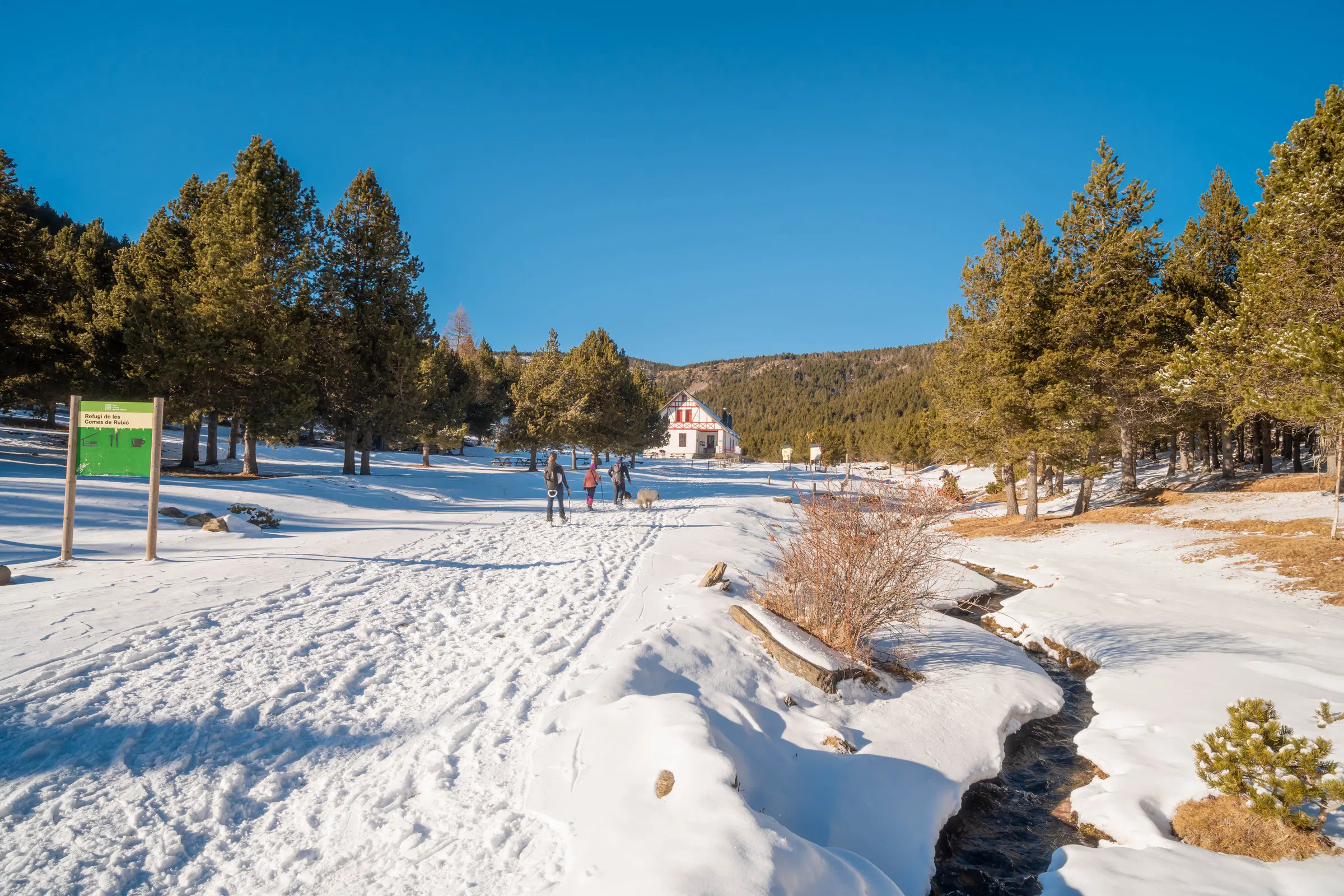
An easy route from Rubió, ideal for trying snowshoeing for the first time and discovering the winter landscapes of the Parc Natural de l’Alt Pirineu.
- Distance: approx. 8.1 km.
- Elevation gain: approx. 285 m.
- Duration: 3–4 hours.
- Difficulty: easy.
- Price: €50 per person.
See the snowshoeing route to Refugi Comes de Rubió
Refugi Pla de la Font from Planes de Son
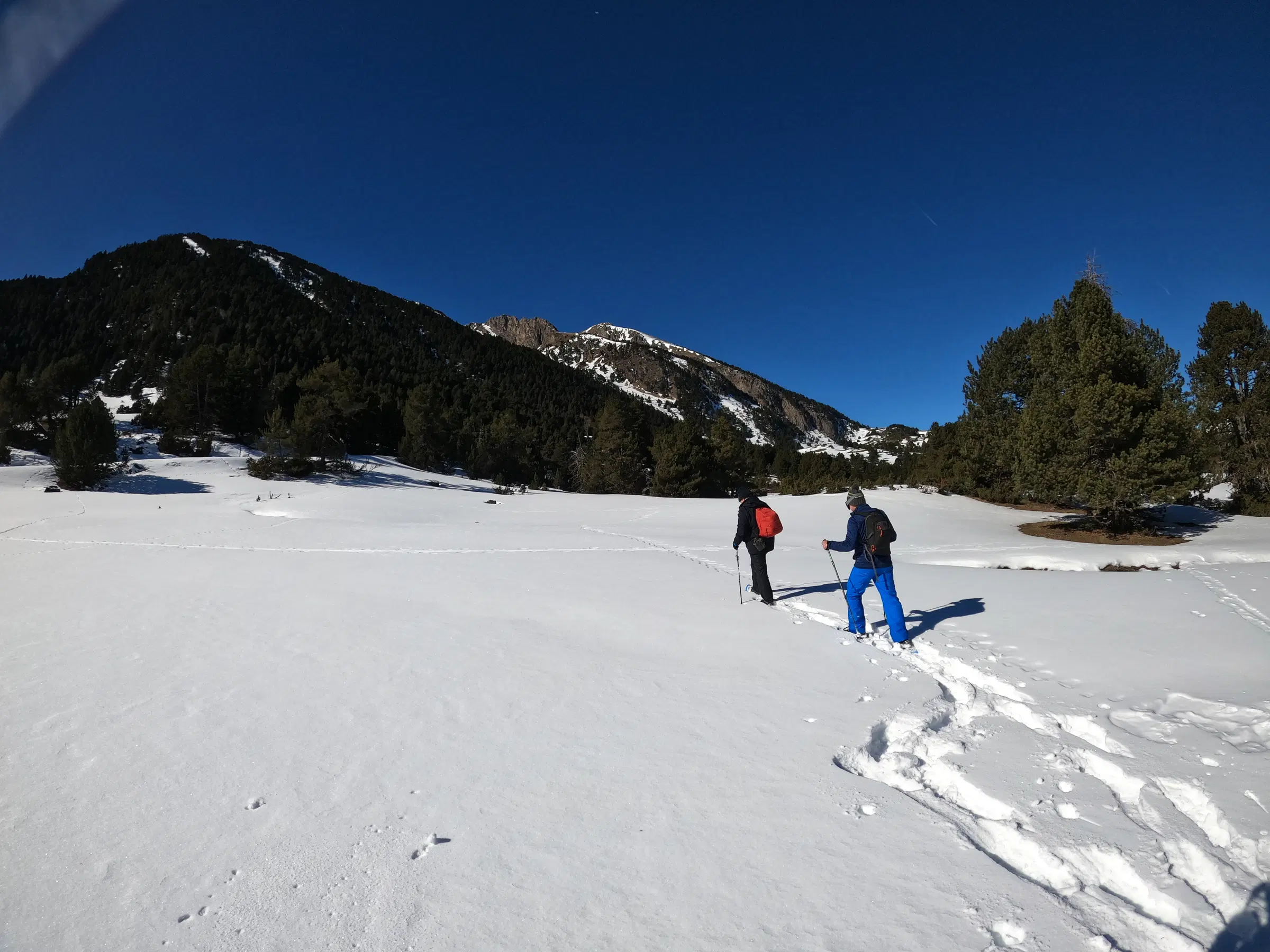
A route through forest and open mountain terrain that climbs gradually to the refuge, located at close to 2,000 metres.
- Distance: approx. 7.5 km.
- Elevation gain: approx. 480 m.
- Duration: 3–4 hours.
- Difficulty: easy to moderate.
- Price: €55 per person.
See the snowshoeing route to Refugi Pla de la Font
Port Ainé – Pic de l’Orri
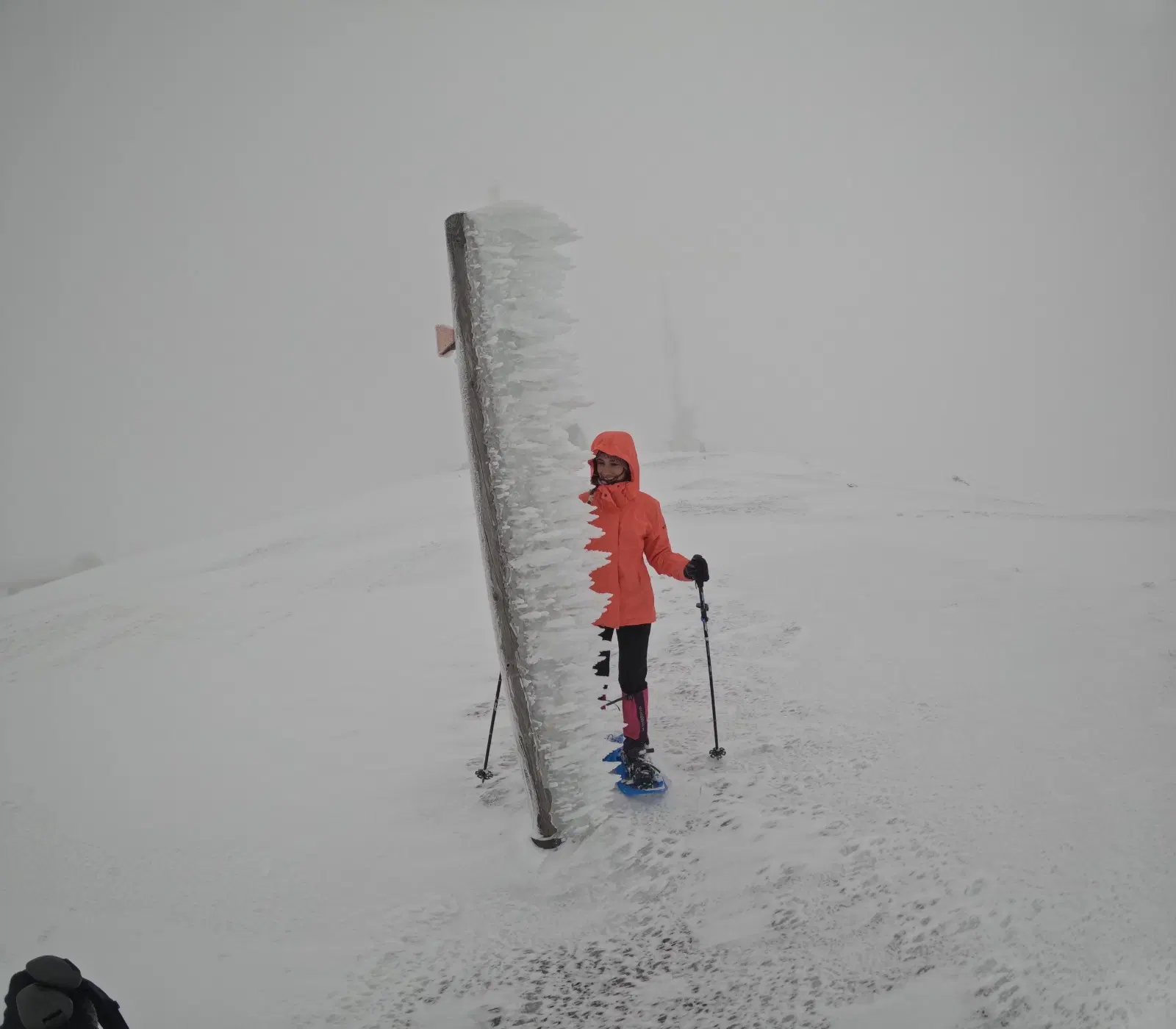
A moderate-level route that takes you from subalpine forest to open high-mountain terrain and up to Pic de l’Orri, at 2,439 m.
- Distance: approx. 7 km.
- Elevation gain: approx. 490 m.
- Duration: around 4 hours.
- Difficulty: moderate.
- Price: €55 per person.
See the Port Ainé – Pic de l’Orri route
Sant Maurici – Refugi d’Amitges
A snowshoe trek through one of the best-known landscapes of Aigüestortes, climbing from Sant Maurici towards Refugi d’Amitges.
- Distance: approx. 10.3 km.
- Elevation gain: approx. 540 m.
- Duration: 4.5–5 hours.
- Difficulty: moderate.
- Price: €65 per person + access transport.
See the Sant Maurici – Refugi d’Amitges route
Pic de la Coma del Forn from Tavascan

Our most demanding option: an ascent from Pleta del Prat towards elevations close to 2,700 metres, intended for people with good physical fitness.
- Distance: approx. 9.5 km.
- Elevation gain: approx. 960–970 m.
- Duration: around 6 hours.
- Difficulty: moderate to demanding.
- Price: €75 per person.
See the route to Pic de la Coma del Forn
Which snowshoeing route should you choose?
A snowshoeing route should be chosen based on more than just distance. Elevation gain, altitude, type of terrain and snow conditions can significantly change the effort required.
- For beginners: Refugi Comes de Rubió.
- For a more complete first outing: Refugi Pla de la Font.
- For a moderate level: Port Ainé – Pic de l’Orri.
- To discover Aigüestortes in winter: Sant Maurici – Refugi d’Amitges.
- For fit and experienced walkers: Pic de la Coma del Forn.
If you are unsure which route to choose, we can recommend one according to your experience, fitness level, group composition and current snow conditions.
How do you walk on snow with snowshoes?
Walking with snowshoes does not require a complicated technique, but it does involve some adjustments compared with normal hiking.
On flat terrain, you can walk fairly naturally, keeping your feet slightly farther apart to avoid stepping on one snowshoe with the other. Poles help with balance and distribute the effort.
When climbing, it helps to shorten your stride and use the heel-lift systems fitted to many mountain snowshoes. On descents, it is important to control each step, place the snowshoe correctly and avoid leaning excessively backwards.
Traverses and steep slopes require more attention, as snowshoes have their limits and do not replace technical equipment when terrain becomes too steep or hard.
Before each activity we explain how to put on the equipment and practise the basic techniques needed for the route.
What types of snowshoes are there?
There are different types of snowshoes depending on the terrain and intended use.
Recreational snowshoes
These are designed for easy terrain and routes with limited elevation gain. They usually prioritise comfort, ease of use and flotation on soft snow.
Mountain snowshoes
These are the most suitable for most of our excursions. They feature stronger traction, durable bindings and usually heel lifts to make climbing easier.
Lightweight or sport snowshoes
These are designed to reduce weight and allow a faster pace. They are used for specific sporting activities, but are not always the most versatile option for mountain excursions.
Snowshoe size also matters. A larger surface offers more flotation in deep snow, while smaller models are easier to handle on firm snow or more technical terrain.
On our excursions we provide snowshoes suited to the planned activity.
Snowshoe hiking: is it difficult?
Snowshoe hiking can be very easy or physically demanding depending on the route.
A forest track with little elevation gain may be perfectly suitable for beginners. A high-mountain ascent with 800 or 1,000 metres of elevation gain, however, requires good physical fitness and previous mountain-walking experience.
Moving through snow generally requires more energy than walking on dry ground. Deep, wet or freshly fallen snow can increase the effort even on apparently easy routes.
That is why we classify the routes by difficulty and adapt the pace to the group.
Snowshoeing for beginners
To start snowshoeing, there is no need to begin with a summit. A first outing should allow you to learn to walk comfortably, use the poles and get used to the behaviour of the snow.
Routes such as Comes de Rubió offer a good introduction because they provide a genuine mountain experience without requiring major elevation gain.
Once you have gained experience, you can progress to longer routes, higher-altitude mountain huts and ascents such as Pic de l’Orri or Coma del Forn.
Snowshoeing with children
It is also possible to go snowshoeing with children, provided the route is adapted to their age, fitness and experience.
On a family outing we usually prioritise moderate distances, limited elevation gain and areas where children can enjoy the snow without turning the activity into an excessively long walk.
Cold conditions also need particular attention. Children can cool down quickly during stops, so suitable clothing, spare gloves and protection from wind and moisture are important.
Before booking a family activity, we recommend telling us the children’s ages so that we can suggest a suitable itinerary.
What do I need for a snowshoeing excursion?
For most of our routes you do not need to own technical equipment. The activity includes:
- mountain guide;
- snowshoes;
- poles;
- civil liability and accident insurance.
Participants should bring waterproof hiking boots, thermal and warm clothing, a waterproof and windproof jacket, gloves, hat, sunglasses and sun protection.
You should also bring enough water and food for the planned duration of the outing.
We recommend dressing in layers, as a snowshoeing excursion alternates between periods of physical effort and stops when the wind chill can drop quickly.
Safety on snowshoeing excursions
Using snowshoes is simple; travelling through the winter mountains is not always so.
Weather, wind, visibility, temperature, road access and snowpack conditions can completely change a route.
Snowshoes also do not remove the risks associated with snow or make every snowy slope suitable for walking.
Before each activity, expected conditions are assessed. During the route, the guide may change the itinerary, alter the objective or establish a different turnaround point if necessary.
For this reason, published distances, elevation gains and timings are approximate.
What is the best time for snowshoeing in the Pyrenees?
There is no exact date. The season depends directly on snowfall, temperatures and how well the snowpack is preserved.
Normally, snowshoeing excursions in the Pyrenees are concentrated in the winter months and, when snow remains in good condition at altitude, may continue into early spring.
Within the same season there may be major differences between December, January, February and March, or even between two areas just a few kilometres apart.
For this reason, we confirm the route according to actual conditions rather than the calendar alone.
Would you like to go snowshoeing in the Pyrenees?
Tell us what kind of experience you are looking for, your level and whether you are coming as a couple, family or group. We will help you choose a route suited to mountain conditions.
We offer snowshoeing excursions for beginners, moderate-level routes and more demanding ascents in different areas of the Lleida Pyrenees.
Frequently asked questions about snowshoeing
What are snowshoes?
They are devices attached to hiking boots to increase the surface area of each step and reduce sinking into the snow. Mountain models also include traction systems and features that make climbing slopes easier.
What are the main snow areas in Catalonia?
The areas with the best possibilities are mainly in the Pyrenees: Val d’Aran, Pallars Sobirà, Alta Ribagorça, Cerdanya, Alt Urgell and parts of Ripollès. Snow coverage and quality vary each season according to altitude and aspect.
Where can you go snowshoeing in Catalonia?
The Catalan Pyrenees offer the widest variety of routes. MundoCanyon works mainly in the Lleida Pyrenees, especially in Pallars Sobirà and around Port Ainé, Tavascan, Planes de Son, Rubió and Sant Maurici.
Where can you go snowshoeing in the Pyrenees?
There are possibilities in many sectors of the Pyrenees. In Lleida, Pallars, Aigüestortes, Port Ainé and Tavascan stand out, with routes ranging from easy walks to genuine high-mountain itineraries.
What types of snowshoes are there?
There are recreational models for easy terrain, mountain snowshoes with stronger traction for slopes and lighter sport models. Size also varies depending on the user’s weight and type of snow.
How do you walk on snow with snowshoes?
The basic technique is to walk naturally while keeping your feet slightly farther apart. On slopes, stride length is adapted and poles are used to improve balance and support. At the beginning of each excursion we explain and practise these techniques.
Do I need previous experience?
Not for beginner routes. For longer itineraries or routes with more elevation gain, it is advisable to be used to hiking and have an appropriate level of fitness.
Can you go snowshoeing with children?
Yes. The route should be chosen according to their age, fitness and experience, with particular attention paid to cold conditions and snow quality.
How long does a snowshoeing excursion last?
Our usual routes take approximately 3 to 6 hours, depending on the itinerary, elevation gain, snow conditions and group pace.
How much does a snowshoeing excursion cost?
The routes currently described start from €50 per person. The price depends on the route and some itineraries may involve additional transport or access costs.
What is the best snowshoeing route for beginners?
Among our routes, the itinerary to Refugi Comes de Rubió is the most accessible, with moderate elevation gain and an estimated duration of 3–4 hours.
What happens if there is not enough snow?
Conditions are checked before the activity. If the planned area is unsuitable, we can change the route, choose another sector or suggest an alternative according to mountain conditions.