 ENG
 Español
 ENG
 CAT

Abandoned villages in Catalonia: 10 surprising places in Pallars and the Lleida Pyrenees
In brief:
- Where they are: many of the most interesting abandoned villages in the Lleida Pyrenees are concentrated in Pallars Jussà, Pallars Sobirà and nearby areas of Alta Ribagorça.
- The most distinctive: Espluga de Cuberes and Solduga stand out for the way they adapt to the terrain; Herba Savina for its history; Montsor for its location; and Aramunt Vell for clearly preserving the structure of an old medieval settlement.
- Not all of them are completely abandoned: some still have a restored house, a minimal permanent population or occasional use.
- How to visit them: some can be approached along mountain tracks, while others require hiking through mountain terrain.
- The key: it is not just about looking at ruins. Old paths, the position of the village, access to water and the surrounding terrain help explain why people lived there and why many settlements were eventually deserted.
- Important: many buildings are in poor condition. Do not enter unstable structures or remove objects from the site.
In the Pallars, a village can disappear without disappearing from the landscape.
Families leave, paths fall out of use and roofs begin to collapse, yet for decades — and sometimes for centuries — streets, stone walls, churches, fountains, old terraces and the paths that once connected the settlement with the rest of the valley remain visible.
That is why exploring some of the abandoned villages in Catalonia found across the Pallars and the Lleida Pyrenees is much more interesting than simply visiting a collection of ruins.
When we walk through these places, we also try to read the landscape. Where did the water come from? Why was the village built on that particular slope? Which path connected it with neighbouring settlements? Where were the crops grown? How long did it take to reach a school, market or doctor?
These questions help us understand why living in places that seem extraordinarily isolated today made perfect sense for centuries — and why many of them began to empty during the 20th century.
In this guide, we have selected ten of the abandoned villages of Pallars Jussà, Pallars Sobirà and other parts of Lleida that we find particularly interesting because of their history, location or the route used to reach them.
Why are there so many abandoned villages in the Pallars?
There is no single explanation.
For centuries, the mountains of the Pallars were occupied by a dense network of small villages, farmsteads, barns and agricultural settlements. Many were located far from today’s valley-floor roads because the economy and transport routes worked very differently.
A path that now looks like little more than a hiking trail might once have been a main route between two valleys. Families farmed small plots, raised livestock, made use of the forests and depended far less on the services we now consider essential.
This balance began to break down particularly during the 20th century.
Agricultural mechanisation, the declining importance of traditional livestock farming, the search for work in larger towns and cities, and the concentration of schools, shops and healthcare services made it increasingly difficult for very small settlements to survive.
Access was another decisive factor. When a new road connected the valley floors, villages located on old mountain routes could suddenly find themselves left outside the main transport network.
That is why, when we talk about abandoned villages in Lleida, each one usually reflects a different combination of isolation, economic change, new forms of transport and changing lifestyles.
1. Espluga de Cuberes: a village built beneath the rock
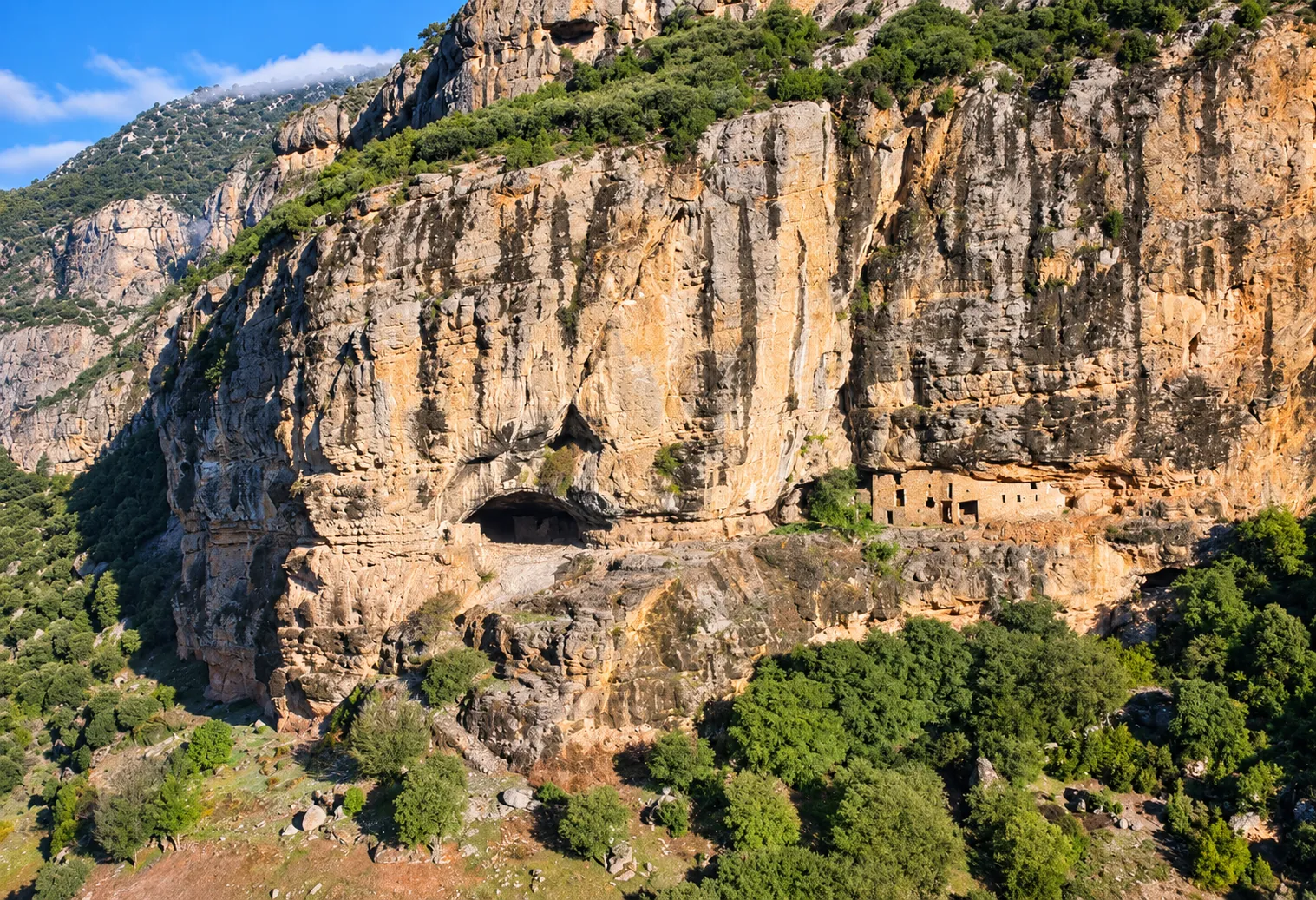
Espluga de Cuberes is probably one of the most remarkable abandoned villages in the Catalan Pyrenees.
It lies in the municipality of Baix Pallars, in Pallars Sobirà, in a location that almost seems deliberately chosen to remain hidden. The buildings make use of a large natural hollow in the rock on the slopes of the Serra de Cuberes, above the Barranc de l’Infern.
This is not the typical group of houses arranged around a village square. Part of the former settlement is built directly beneath the shelter of the rock face, which is why it is often described as a troglodyte village.
Among the surviving remains is the church of Santa Coloma de l’Espluga, also integrated into this unusual natural shelter beneath the rock.
The settlement is documented from the Middle Ages and already appears in written sources from the 12th century.
But one of the best ways to understand Espluga de Cuberes is not simply to look at what remains of the village, but to experience the route used to reach it. There is no conventional road ending in front of the houses. Visiting it means entering a rugged landscape of forests, ravines and old mountain paths.
That is precisely why it is such a good example of how an abandoned village should be explored: the route itself is part of the story.
Would you like to discover Espluga de Cuberes?
At MundoCanyon, we organise a route combining 4×4 access, hiking and interpretation of the landscape and the village’s history.
2. Solduga: Espluga de Cuberes’ sister village
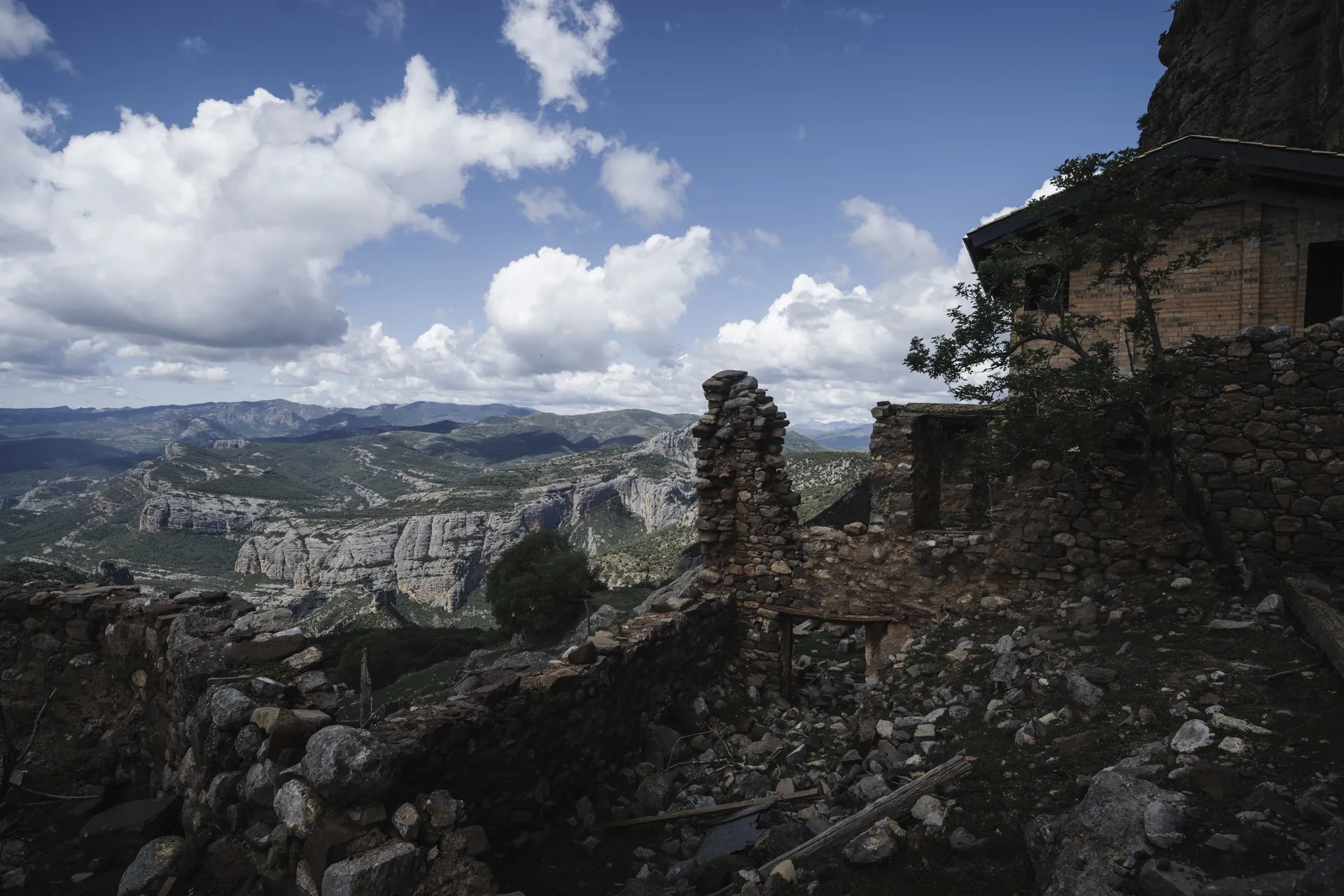
Very close to Espluga de Cuberes lies Solduga, another former settlement in Baix Pallars, located in the Serra de Cuberes above the Barranc de l’Infern.
The two places were historically closely connected and have long appeared together under the name Solduga i l’Espluga de Cuberes. Even so, Solduga has a character of its own and deserves to be considered separately.
The village stands at around 1,260 metres above sea level, in steep, isolated terrain that clearly illustrates the difficulties of maintaining a permanent population in this part of the mountains.
One of its most interesting features is the remains of the Romanesque church of Sant Martí de Solduga, built on a narrow platform beside the rock face.
The settlement is documented from the beginning of the 13th century and formed part of a historic network of small communities that made use of even the most inaccessible-looking parts of the Serra de Cuberes.
The relationship between Solduga and Espluga is particularly interesting because it allows us to compare two neighbouring settlements that adapted to the same difficult landscape in different ways.
Reaching Solduga is not a conventional roadside visit either. Access follows mountain tracks and rough terrain and may require an approach on foot depending on the chosen itinerary and the condition of the tracks.
Here, isolation is not simply a logistical inconvenience: it is one of the keys to understanding the village’s history.
3. Herba Savina: a village in the Boumort area
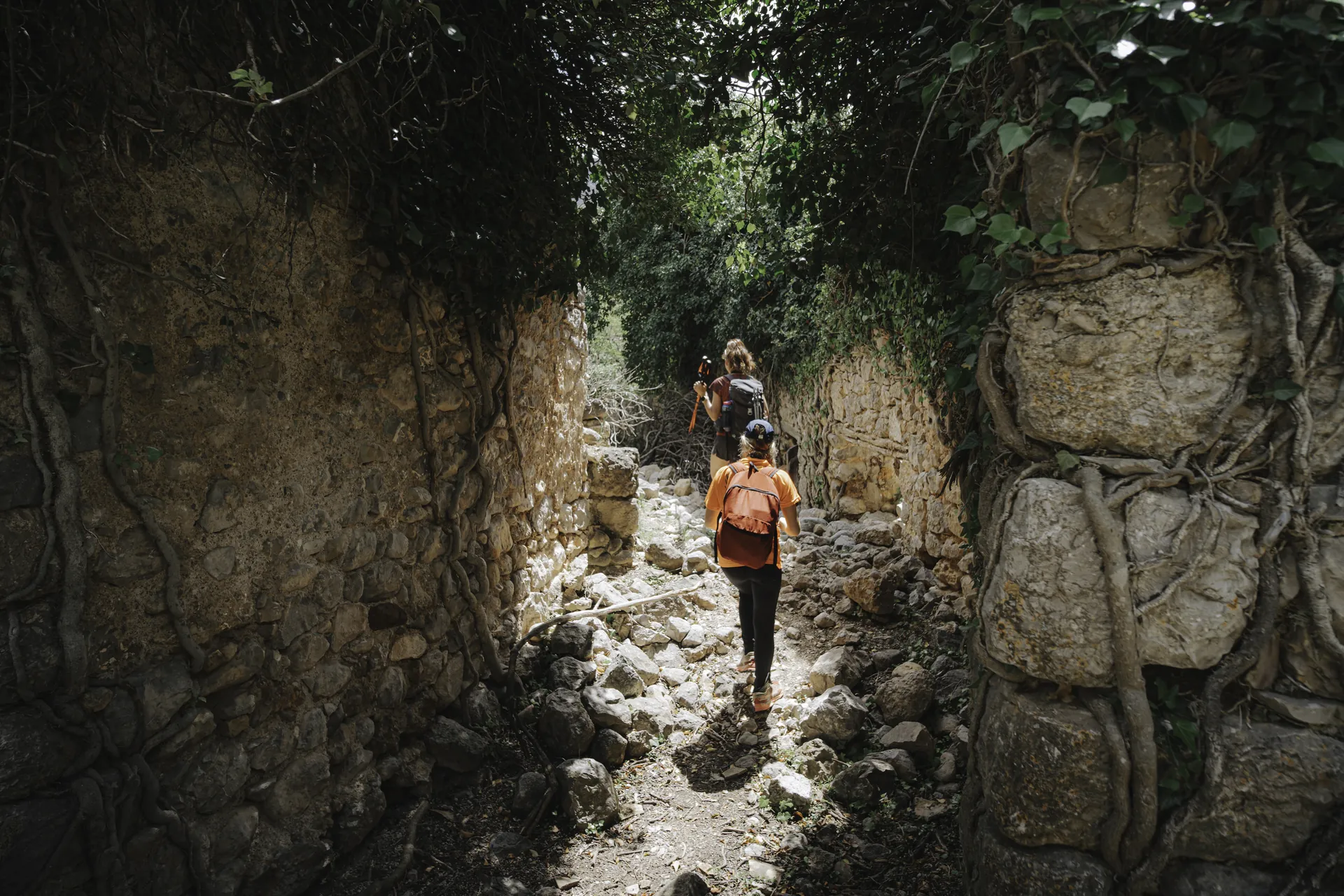
Herba Savina — historically written in several forms, including Erbasabina, Erbasavina and Herba-sabina — belongs to the municipality of Conca de Dalt, in Pallars Jussà.
Its location quickly reveals one of the main difficulties faced by many small Pre-Pyrenean settlements: distance.
A landscape that today seems perfect for walking, wildlife watching or simply enjoying the silence represented a far harsher reality for people who had to live there all year round, transport goods or access basic services.
The population gradually declined during the second half of the 20th century until the village was left almost empty.
But Herba Savina also has a particularly interesting history that goes far beyond depopulation. The village became associated with one of the best-known criminal cases in this part of the Pallars, an episode that still forms part of local memory.
For that reason, we have created a specific route where the village can be discovered within its historical and landscape context.
Discover the Herba Savina route →
Much of the appeal of this area is also closely linked to the surrounding territory. To understand its wildlife, relief, geology and landscapes in greater depth, see our complete guide to the Boumort Reserve.
4. Montsor: the old village above Collegats
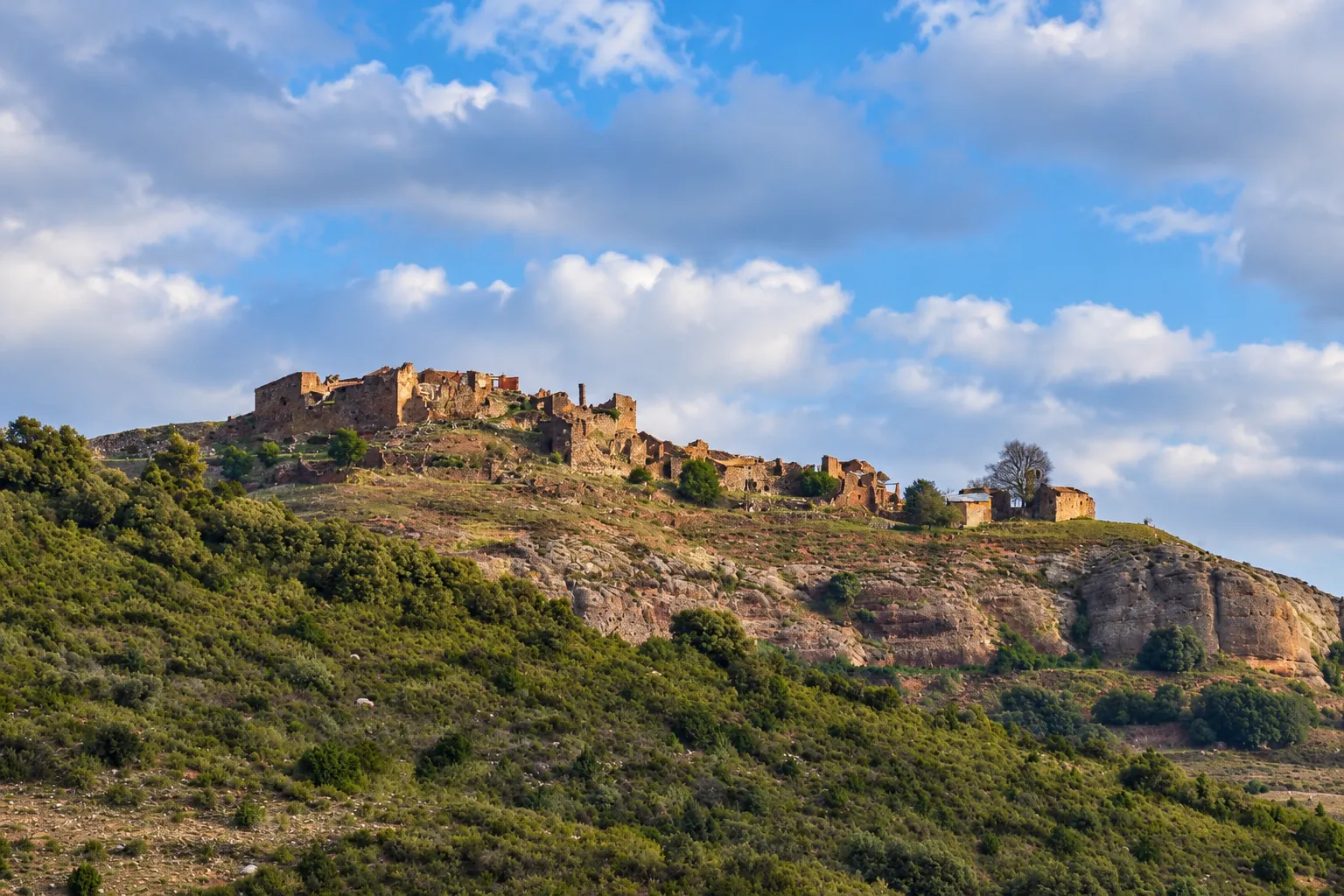
You do not have to travel far from La Pobla de Segur to find another striking example of mountain depopulation.
Montsor lies at more than 1,200 metres above sea level, on the heights overlooking the entrance to the Collegats area.
Its location may seem unusual today, but historically it made much more sense.
Old routes connecting the two Pallars once crossed this area, before modern transport concentrated much of the traffic along the valley floor and through the Collegats gorge.
As the transport network changed, Montsor gradually found itself away from the new routes. Difficult access, lack of services and the transformation of traditional agriculture and livestock farming added further pressure.
The settlement finally became depopulated during the second half of the 20th century.
Today it remains a particularly interesting place to reach on foot because the route makes its position easy to understand. As you gain elevation, broad views open up across Conca de Dalt, Collegats and the mountains separating the two Pallars.
In this case, rather than asking, “Why did they build a village so high up?”, it is more useful to reverse the question: what important route passed through here when the village was inhabited?
5. Aramunt Vell: a medieval vila closa overlooking the Conca
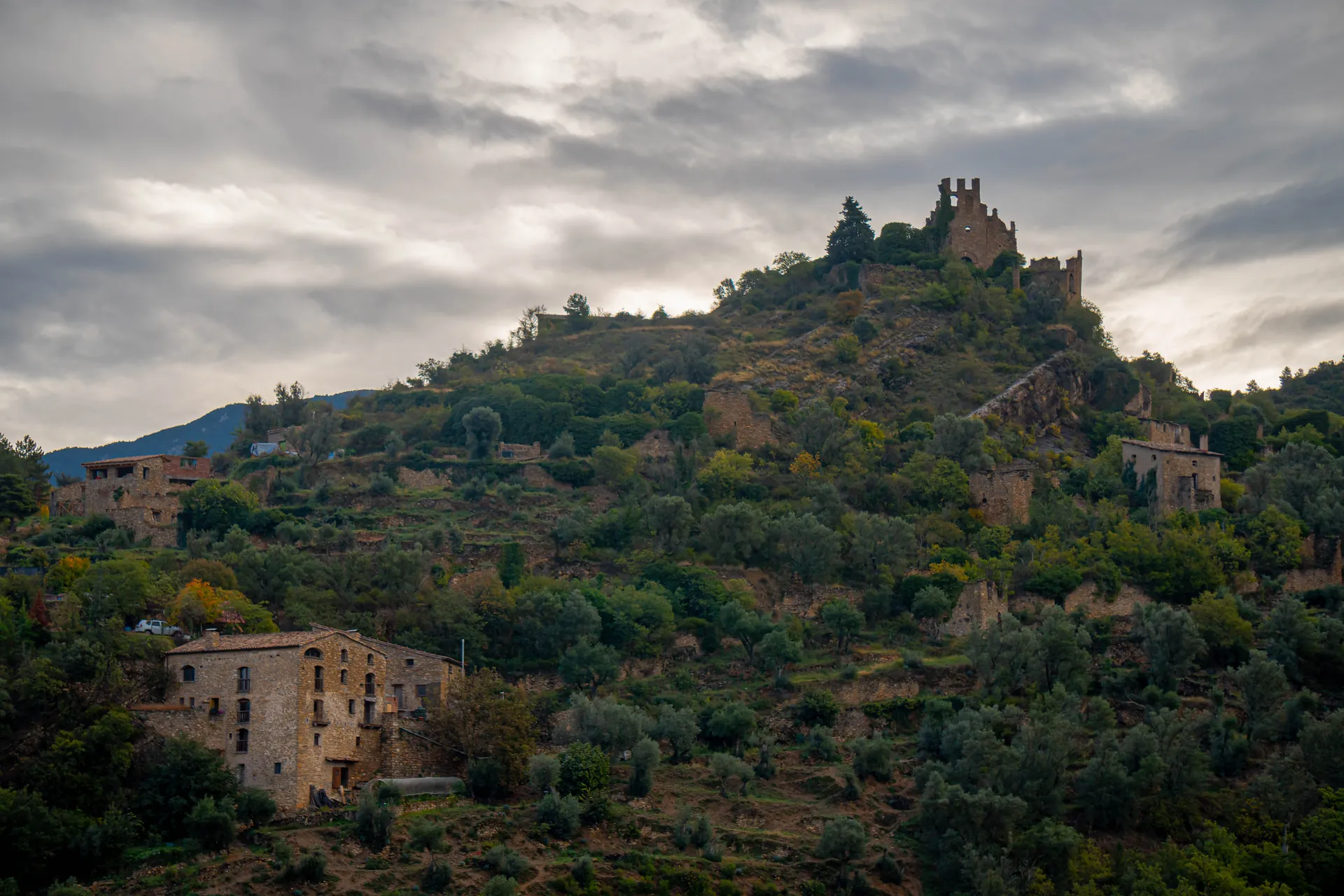
Aramunt Vell is one of the most accessible and visually interesting historic settlements in Pallars Jussà.
It occupies a hill above present-day Aramunt and clearly preserves the structure of an old vila closa: a compact, defensive settlement in which the buildings themselves helped close off the perimeter.
Among the ruins, you can still make out streets, former access points and the remains of the church of Sant Fructuós, located in the upper part of the settlement.
The elevated position offered defensive advantages and control over the surrounding territory, but over time the same slopes and narrow streets that had made sense in a medieval village became a disadvantage when adapting to new forms of transport and everyday life.
The population gradually moved towards present-day Aramunt during the 20th century, leaving the old settlement almost empty.
However, an important distinction is needed here: describing a place as an “abandoned village” does not always mean that absolutely no activity remains. Restoration initiatives have taken place in Aramunt Vell and at least some buildings have been rehabilitated.
This makes it a particularly good example of the boundary between ruins, depopulation and heritage recovery.
6. La Bastida de Bellera: ruins above Vall de Bellera
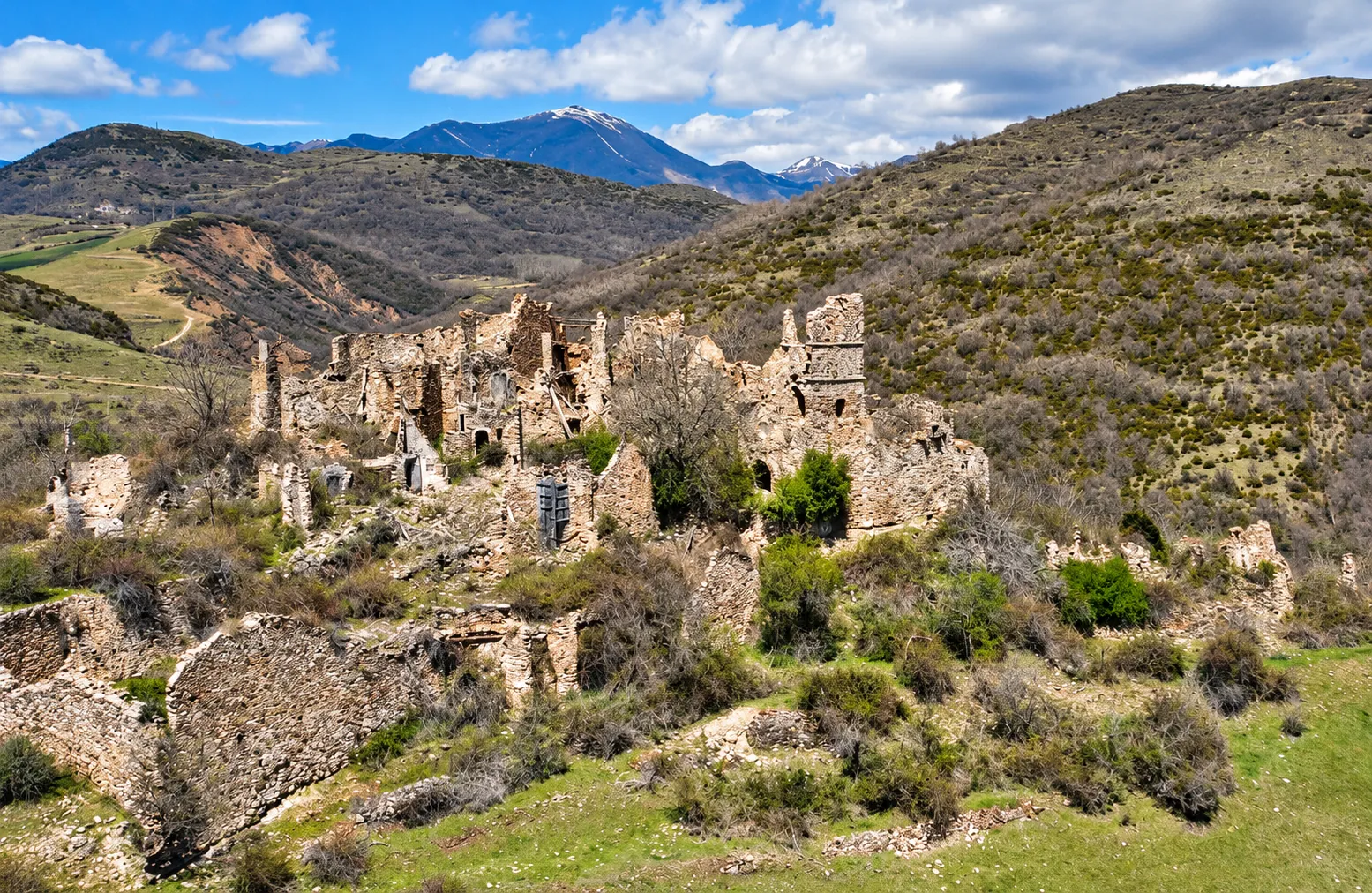
La Bastida de Bellera belongs to the municipality of Sarroca de Bellera, in Pallars Jussà.
The former settlement occupies an elevated position above Vall de Bellera and retains the remains of houses and its church.
But one of the elements that makes this area especially interesting lies outside the village itself.
From La Bastida, it is possible to descend towards the so-called Pont del Diable, an old bridge over the ravine associated with the historic paths of this area.
The surroundings can be explored on routes linking the former village with other points in the valley, meaning the visit can be approached not simply as a stop beside some ruins, but as part of a journey along old communication routes.
It is precisely this combination — village, path and landscape — that best helps explain how the territory functioned before today’s road network existed.
7. El Meüll: between abandoned village and almost deserted settlement
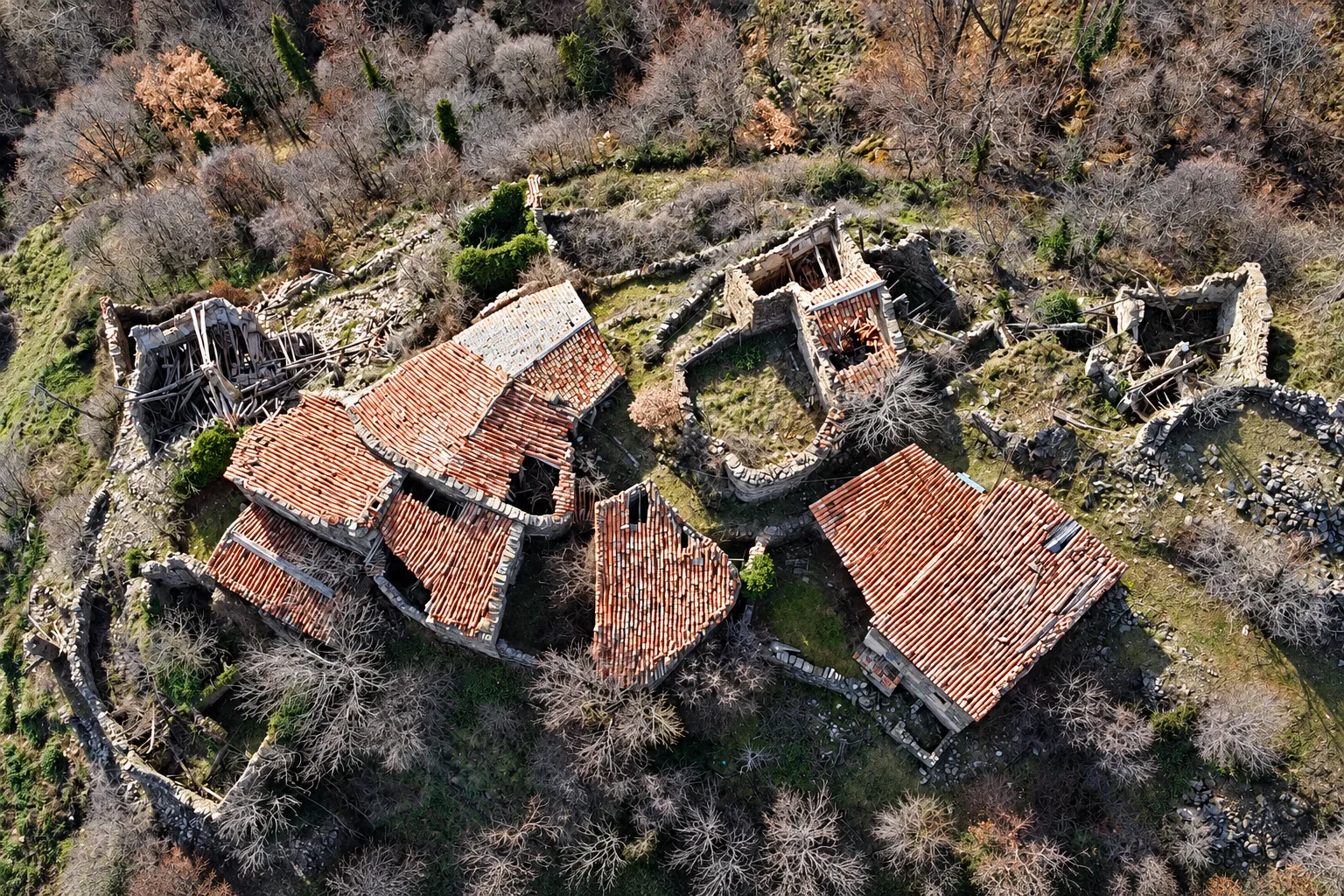
El Meüll, also in the municipality of Sarroca de Bellera, deserves a place on this list precisely because it forces us to qualify what we mean by an abandoned village.
The settlement lies near the Barranc de la Coscolla, in a sparsely populated mountain area.
Many of its buildings are in ruins and for years the population has been minimal. However, it has not always been technically uninhabited, so it is more accurate to describe it as an almost deserted settlement rather than a completely abandoned village.
The church of Sant Esteve remains one of its most recognisable buildings.
This case is important because it shows that depopulation does not always have a clear final stage. Some villages disappear completely; others retain a minimal presence, maintain second homes or recover certain activities after years of decline.
8. Espluga Freda: a small settlement in the mountains of Tremp
Within the enormous municipality of Tremp there are numerous scattered small settlements, some of which are now deserted.
One of the most interesting is Espluga Freda, historically connected with the Sapeira area.
Much of the village is in ruins, but the structure of the former settlement can still be recognised, with the church of Sant Esteve remaining an important landmark.
Its appeal lies above all in the overall setting: stone houses, silence, Pre-Pyrenean terrain and a location that shows just how widely dispersed the population once was across places that today seem remote.
Access is via rural tracks and paths, so it is always advisable to check their condition before setting out.
In places like this, one idea is worth remembering: a line shown on a map does not necessarily mean there is a road suitable for every vehicle.
9. Sant Romà de Tavèrnoles: a village you have to reach on foot
In Pallars Sobirà we find Sant Romà de Tavèrnoles, another deserted settlement whose interest is closely linked to the route used to reach it.
Getting to the former village requires a considerable climb from the valley floor.
This is not a place where you simply “park and look”. The route requires walking, gaining elevation and gradually leaving the main roads behind.
And that is precisely what makes it interesting.
When a route requires a long climb to reach a small village, it becomes much easier to imagine what daily life meant when every journey had to be made on foot or with pack animals.
Abandoned villages stop being picturesque photographic backdrops and become a way of reading the mountain landscape.
10. Erillcastell: a deserted village in Alta Ribagorça
To extend the journey beyond the Pallars, we can head towards Alta Ribagorça, where we find Erillcastell.
This former village now belongs to the municipality of El Pont de Suert and lies in a mid- to high-mountain setting.
Access was always difficult, and the gradual loss of population eventually left the settlement empty.
Among the surviving elements is the former church of Santa Maria d’Erillcastell, while little recognisable remains of the castle that gave the settlement its name.
The surrounding area was also historically linked to nearby mining activity, another example of how particular resources could support small settlements while employment and economic activity remained available.
Today, Erillcastell broadens the picture: the phenomenon of abandoned villages is not limited to Pallars Jussà but can be found across many mountain areas of Lleida.
Not all abandoned villages are the same
The expression abandoned village is useful when searching for information, but on the ground it is much less precise than it might seem.
We can find very different situations:
- completely uninhabited settlements, where all or almost all homes have been abandoned;
- almost deserted villages, with one or very few residents;
- old abandoned settlements beside a modern village, as in Aramunt;
- places with a few restored houses after decades of abandonment;
- settlements used as second homes only during certain times of year.
That is why we prefer to check each case rather than describe a village as completely empty simply because it looks abandoned.
And the fact that a house appears abandoned does not mean that it has no owner.
How to visit abandoned villages safely and respectfully
Ruins can be very attractive, but it is important to remember that many buildings have gone for decades without maintenance.
A wall may look stable when it is not. A floor can collapse. A partially fallen roof may shift after wind, rain or snow.
We therefore recommend following a few basic rules:
- Do not enter buildings in poor condition. An open doorway does not mean that it is safe to go inside.
- Respect private property. A deserted settlement is not necessarily public space.
- Do not remove objects. Tools, wood, ceramics and other items form part of the place and may still have an owner or heritage value.
- Close gates that you find closed. Many tracks cross livestock areas.
- Do not rely solely on Google Maps. A track shown on the map may be damaged, closed or unsuitable for a normal car.
- Carry water, a map and enough battery power. Some villages are far from services and mobile coverage may be limited.
- Assess the weather. A straightforward track in dry conditions can change dramatically after rain, snow or ice.
- Allow for the return journey. Reaching the village is only half the route if you have walked there.
And there is one particularly useful rule in the mountains: reaching a point shown on the map does not necessarily mean there is a driveable road all the way to it.
Routes for discovering abandoned villages and landscapes of the Pallars
For us, the most interesting way to discover these places is to include them as part of a route.
That way, the village stops being merely the destination and we begin to understand the paths its inhabitants used, its relationship with neighbouring settlements and the logic of the surrounding landscape.
At MundoCanyon you will find different options for hiking in the Pyrenees, some of them directly linked to historic villages and landscapes of the Pallars.
Among the most representative are the route to the abandoned village of Espluga de Cuberes and the Herba Savina route.
Another completely different option is the 4×4 smugglers’ route and the village of Tor.
Tor is not an abandoned village, but its isolation, proximity to the border and history of old smuggling routes help explain how people lived and moved through these mountains before modern roads existed.
Discover the Pallars beyond the road
Some villages and landscapes only really make sense when explored on foot or along old mountain tracks. We can adapt the activity to the group’s level and interests.
From abandoned villages to major natural areas
One of the most interesting things about the Pallars is the number of very different landscapes concentrated within a relatively small area.
Herba Savina, Solduga and Espluga de Cuberes take us into the surroundings of Boumort, Cuberes and Collegats, a territory shaped by rugged relief, forests, ravines and an important population of wild animals.
To discover this area in greater depth, see our complete guide to the Boumort Reserve, where we explain its geology, wildlife, routes and the best seasons to visit.
Farther north, the landscape changes completely. In Aigüestortes i Estany de Sant Maurici National Park, granite, glacial landforms and hundreds of high-mountain lakes dominate the scenery.
Moving from Boumort to Aigüestortes is a good way to understand why the expression “Lleida Pyrenees” encompasses areas that can be very different in terms of geology, climate and landscape.
What else to do in the Pallars besides visiting abandoned villages
The same rugged terrain that made communication difficult for centuries and contributed to the isolation of some villages is now one of the Pallars’ greatest attractions.
Its rivers and ravines make it ideal for canyoning in the Pyrenees; its rock walls provide routes for via ferratas; and in winter many mountain areas can be explored on snowshoe excursions.
The natural calendar also changes the way the territory can be experienced.
In autumn, for example, Boumort and other Pre-Pyrenean areas become especially interesting places to hear and observe the red deer rut in Catalonia.
A trip initially focused on rural heritage can therefore easily become several days of hiking, wildlife watching, geology and mountain activities.
Spending several days in the Pallars?
You can combine villages and rural heritage with hiking, 4×4 routes, canyoning, via ferratas, wildlife watching or snowshoe excursions depending on the season.
What is the best time to visit abandoned villages in the Pallars?
Most can be visited during much of the year, but each season brings different conditions.
Spring
The forests turn green again, streams carry more water and temperatures are usually pleasant.
On the other hand, rain can leave tracks muddy and snow may still remain at higher elevations.
Summer
Long days make it possible to plan extended routes, but some parts of Pallars Jussà and Boumort can become very hot around midday.
On exposed routes with little shade, it is much better to start early.
Autumn
This is one of our favourite times of year for exploring many Pre-Pyrenean areas.
Temperatures are usually more comfortable, the forests change colour and it also coincides with one of the great wildlife events of the year: the red deer rut.
Winter
Villages at lower elevations may remain accessible, but conditions vary greatly depending on aspect and altitude.
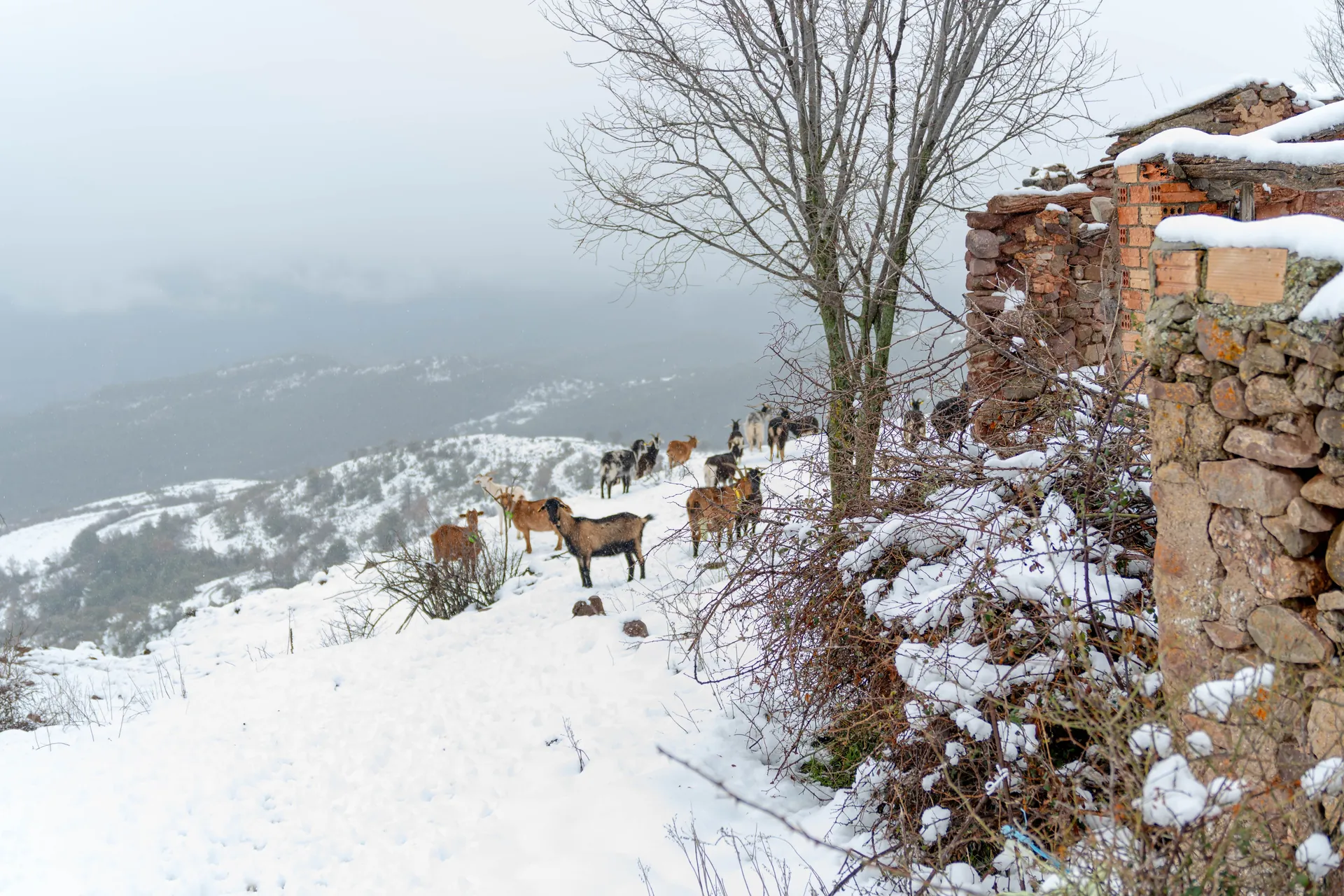
Ice can turn apparently easy paths into difficult terrain, and some tracks become covered by snow.
At higher elevations, winter opens up other possibilities, such as snowshoe routes in the Pyrenees.
Which abandoned village should you choose?
| If you are looking for… | We recommend |
|---|---|
| The most unusual location | Espluga de Cuberes |
| A remote settlement linked to Espluga and Serra de Cuberes | Solduga |
| History, isolation and Boumort | Herba Savina |
| Wide views and a good hiking route | Montsor |
| A medieval settlement that is easy to interpret | Aramunt Vell |
| Historic routes and rural heritage | La Bastida de Bellera |
| Understanding an incomplete depopulation process | El Meüll |
| A little-known place in Pallars Jussà | Espluga Freda |
| A hike that helps explain isolation | Sant Romà de Tavèrnoles |
| Extending the route towards Alta Ribagorça | Erillcastell |
Frequently asked questions about abandoned villages in Catalonia and Lleida
Where can you find abandoned villages in Catalonia?
Deserted settlements can be found in many rural and mountain areas of Catalonia. In the Lleida Pyrenees, Pallars Jussà, Pallars Sobirà and Alta Ribagorça stand out in particular, where the historically dispersed population and isolation of some settlements contributed to depopulation during the 20th century.
Which abandoned villages are there in Pallars Jussà?
Some of the most interesting are Herba Savina, Montsor, Aramunt Vell, La Bastida de Bellera and Espluga Freda. El Meüll is a more complex case, as it has maintained a minimal population at different times and is more accurately described as an almost deserted settlement.
What is the connection between Solduga and Espluga de Cuberes?
They are two former settlements very close to each other in Baix Pallars, in the Serra de Cuberes and Barranc de l’Infern area. Historically they were closely connected, although each has its own characteristics. Their locations provide a very clear example of how mountain communities adapted to exceptionally rugged terrain.
Which is the most spectacular abandoned village in the Pallars?
It depends on what you are looking for. Espluga de Cuberes stands out for its location beneath a huge rock face; Solduga for its isolation; Montsor for the views; Herba Savina for its history and connection with Boumort; and Aramunt Vell for clearly preserving the structure of an old medieval settlement.
Can you drive to the abandoned villages?
Not always. Some can be approached by mountain track, while others require walking. Track conditions may also change because of rain, snow, landslides or access restrictions. Never assume that a track shown on a map is suitable for every type of vehicle.
Is it safe to enter abandoned houses?
We do not recommend it. Many buildings have deteriorated roofs, floors and walls and can collapse without warning. An apparently abandoned house may also still be private property.
Can Espluga de Cuberes be visited?
Yes. The village can be reached on foot, and MundoCanyon organises an activity combining a 4×4 approach, hiking and interpretation of the landscape and local history.
What is the best time to visit abandoned villages in Lleida?
Spring and autumn usually offer particularly pleasant temperatures for walking. In summer, exposed areas are best avoided around midday, while in winter you should check for snow, ice and the condition of mountain tracks.
Are there guided routes to abandoned villages in the Pallars?
Yes. MundoCanyon organises routes connected with places such as Espluga de Cuberes and Herba Savina, as well as other hiking and 4×4 activities that explore the history and landscapes of the Pallars.